



Bioethanol Fireplaces Categories


Shop by brand


Carl Bioethanol Fireplace - Cast Iron
Choose your option


Victoria Bioethanol Fireplace - Cast Iron
Choose your option


Ulvik - Cast Iron Bioethanol Fireplace
Choose your option


Molde - Cast Iron Bioethanol Stove
Choose your option


Bergen - Cast Iron Bioethanol Fireplace
Choose your option


Spitsbergen - Cast Iron Bioethanol Stove
Choose your option


Westbo Classic - Black Freestanding Bioethanol Fireplace
Choose your option


Westbo Carl 120 Bioethanol Fireplace - Cast Iron
Choose your option


Regal 152 Electric Fireplace
Choose your option


Ignite Evolve 50
Choose your option

Choose your option


Infinity 81 cm Electric Fireplace
Choose your option


Opti-V Single - 1-sided built-in fireplace without heat
Choose your option


PowerFlame 1 Electric Fireplace Insert
Choose your option


Aflamo LED Pro Built - in Electric Fireplace - 80 cm
Choose your option


Royal Pro Wall-Mounted Electric Fireplace - Black - 180 cm
Choose your option


Lambeth White - Tabletop Bio Fireplace
Choose your option


Lambeth Tabletop Bioethanol Fireplace - Black
Choose your option


Lambeth Tabletop Bioethanol Fireplace - Steel
Choose your option


Southwark White - Round Tabletop Bioethanol Fireplace
Choose your option


Southwark Black - Round Tabletop Bioethanol Fireplace
Choose your option


Circular Table Bio Fireplace - Steel
Choose your option


Kennington Round Tabletop Bioethanol Fireplace - White
Choose your option


Kennington Round Tabletop Bioethanol Fireplace - Black
Choose your option
Bioethanol Fireplace Ltd.
Bioethanol Fireplace welcomes you to our large online fireplace shop, where we sell everything from bioethanol fireplaces, electric fireplaces and water vapour fireplaces to braziers, patio heaters, and much more!
We started as a dealer of environmentally friendly bioethanol fireplaces, and have since expanded our range to include electric fireplaces and Opti-Myst fireplaces, as well as outdoor products such as electric patio heaters, gas heaters and fire pits. With many years of experience and operations in 10 European countries, we're confident we have just what you're looking for — whether among our own fireplaces or other well-known brands in our range.
Looking for a classic-looking ethanol fireplace, a space-saving wall-mounted bio fireplace, or a striking central design element? Find your dream fireplace in our full product range here.
Our skilled team is always ready to help, guide, and advise you in finding the right fireplace or fire pit. We take pride in sharing our product knowledge — through our guides, our YouTube videos, in our showrooms, or via live chat.
Questions, big or small? Reach us via live chat, email, phone, Facebook, or Instagram.


More about Bioethanol Fireplace
Bioethanol Fireplaces: The Eco Friendly Fireplace Without Chimney or Flue!
A bioethanol fireplace is powered by bioethanol fuel and can be installed without a chimney or flue. It is, therefore, an extremely flexible fireplace, available within many price ranges and types for both homes and businesses. A bioethanol fire has become very popular in recent years, in part because of its great flexibility, and the fact, that it is one of the most eco friendly and easy-to-clean fireplaces on the market.
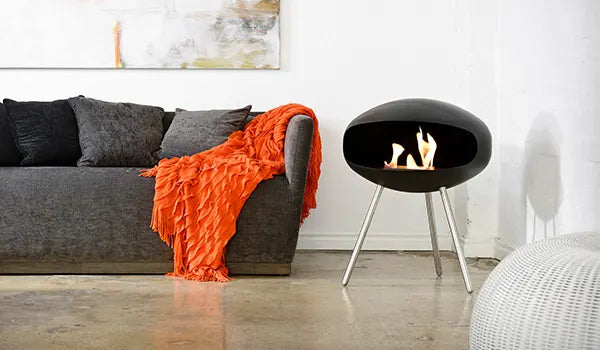
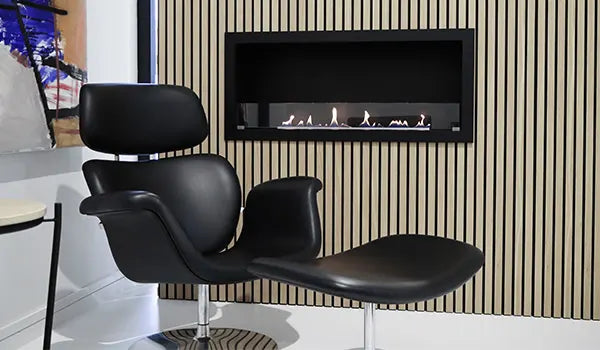
Bioethanol fireplaces come in all types and designs, and can be installed virtually anywhere, whether it is a freestanding bio fireplace, mounted bio ethanol fireplace or built-in bio fireplace.
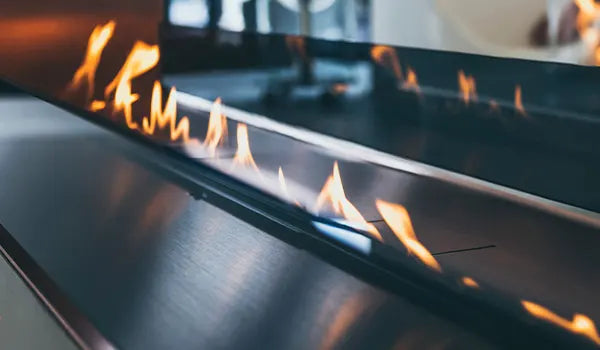
The flame in bio fires is real and provides heat but can also be used as a decorative cosy fireplace if desired. Bioethanol fires comes in both manual and automatic versions that can be operated via remote control, smartphone, or app.
If you want to bring the cosiness of your bio fire outdoors, it is also possible to buy outdoor bio fireplaces from us.
Electric Fireplace: Flames Created by a Power Outlet
Installing an electric fireplace in your home has never been easier! An LED fire is powered by electricity and is particularly attractive to solar homeowners with excess energy. They are incredibly easy to connect and do not require complicated installation in the form of a chimney, flue, or similar. Our electric fireplaces are available as freestanding, mounted, or built-in models.
You might think an LED fireplace is smart, but you miss the warmth of the classic wood-burning stove? No problem because most electric fireplaces comes with a heating module, so you still get the cosy warmth of the fireplace - just without the open fire, smoke, and ash!
A lot of people choose an electric fireplace, because there is no fire hazard involved. They do not produce real flames but electronic ones using LED lights, so the "fire" is always under full control.
You can find our range of different electric fireplaces here.
Outdoor Fireplaces: Fire Pits, Patio Heaters, Pizza Ovens and More!
The latest addition to our product range is our outdoor range, which includes everything from fire pits, pizza ovens, and barbecues to gas patio heaters and electric patio heaters, outdoor bio-fireplaces, and garden fireplaces. So, if you need to create cosiness and warmth on the patio or in the garden on long summer evenings, we are sure to have what you need!
We have a wide range of outdoor cooking products for you to find here. We have brands such as Heatstrip and Happy Cocooning that make both barbecues and pizza ovens, so you can cook delicious food outdoors.
In our outdoor range, we also have various outdoor fires, such as braziers and garden fireplaces. Our fire pits come in many different sizes, shapes, and materials, so there is sure to be one for you and your garden! We also have a lot of accessories for fire pits, so you can cook over the fire, for example. Find our fire pits right here.
If you want to keep the patio warm, an electric patio heater or gas patio heater will keep you warm on the patio during long summer evenings, when the sun goes down and it gets a little cooler! You can find our many different patio heaters and outdoor fires here. And if you would like to bring a bioethanol fire into the garden, on the balcony, or the patio, we also have many outdoor bio fireplaces which you can find here or you can build your outdoor fireplace, e.g., you can build it into a table.
Wall Mounted Bioethanol Fireplace: For Every Home, Even if Space is Scarce
Hang your bioethanol fireplace on the wall, and add stunning new life to your living room or kitchen. It takes up almost no space, so it fits in almost any home. Installing a wall mounted fireplace is incredibly easy and the vast majority of walls can support the weight of a wall-hung bioethanol fire. However, always be aware of the load bearing capacity of the wall and the weight of the fireplace, as this can vary from fireplace to fireplace.
The latest addition to the range of bio fireplaces is ceiling-mounted bioethanol fireplaces! An extremely popular ceiling-mounted model is the Cocoon Aeris from Cocoon Fires. We have a number of different ceiling-mounted bioethanol fireplaces within our range, which can be found together with our wall-mounted bio ethanol fires.
You can find both our wall-hung and ceiling-hung bio fireplaces right here.
Opti-myst Fireplace: The Water Vapour Fireplace that Creates Flames from Water
To most people, it sounds crazy that flames can be created by water, as water and electricity is usually not a good combination. But with the hybrid fireplace, water, electricity, and LED light combine to create the beautiful and very lifelike Opti-Myst flame. Hybrid fireplaces, or water damp fireplaces, are here to stay.
Major manufacturers such as Dimplex, Magic-Fire by Saffretti, and Glow Fire are the first to make these wondrous fireplaces, and between them, there is a huge range of both freestanding, built-in, or hanging hybrid fireplaces.
Opti-Myst fireplaces create an incredibly lifelike flame without any fire hazard and they give off no heat. This kind of fireplace is extremely eco-friendly!
You can see our large selection of the cool Opti-Myst Water Vapour fireplaces here.
Accessories for Your Bioethanol Fires
Bioethanol fires are not complete without the right accessories. The first and most important thing you need is, of course, the bioethanol fuel. Our bioethanol fuel is of the highest quality, and therefore, emits virtually no odour and soot.
The bioethanol used in a bio fireplace should have an alcohol percentage of between 95% - 97.5% for it to burn as cleanly and odourless as possible. Our bioethanol has an alcohol percentage of 96.6% and you can find our bioethanol here.
In addition to bioethanol fuel, it can also be nice to have the right tools for filling, cleaning, and lighting the fire. We, therefore, have a large selection of accessories for you and your bioethanol fireplace, which you can find here.
If you want to spice up your bio fireplace or make it more realistic, we also have lots of decorations for bio fireplaces. Here you can find ceramic wood, ceramic stones, or glow flame which make realistic sparks.


